Aman Gopolani – CPActive Champion
As an Indian Australian living with Cerebral Palsy, from a young age I was exposed to two realities in the same world.
In Australia, extensive government insurance schemes enabled me to access the best quality treatment services, whilst NGOs such as Cerebral Palsy Alliance provided me with a community that fought for my inclusion in society. In my motherland, those with my condition lived far from this reality. The defining experience was when I visited my uncle’s hospital in rural Gujarat, and saw a child with severe Cerebral Palsy whose mother had no knowledge of what condition he had, no funding to afford treatment, and was worried she would have to amputate his leg. Here, I learnt Cerebral Palsy around the world was not created equal.
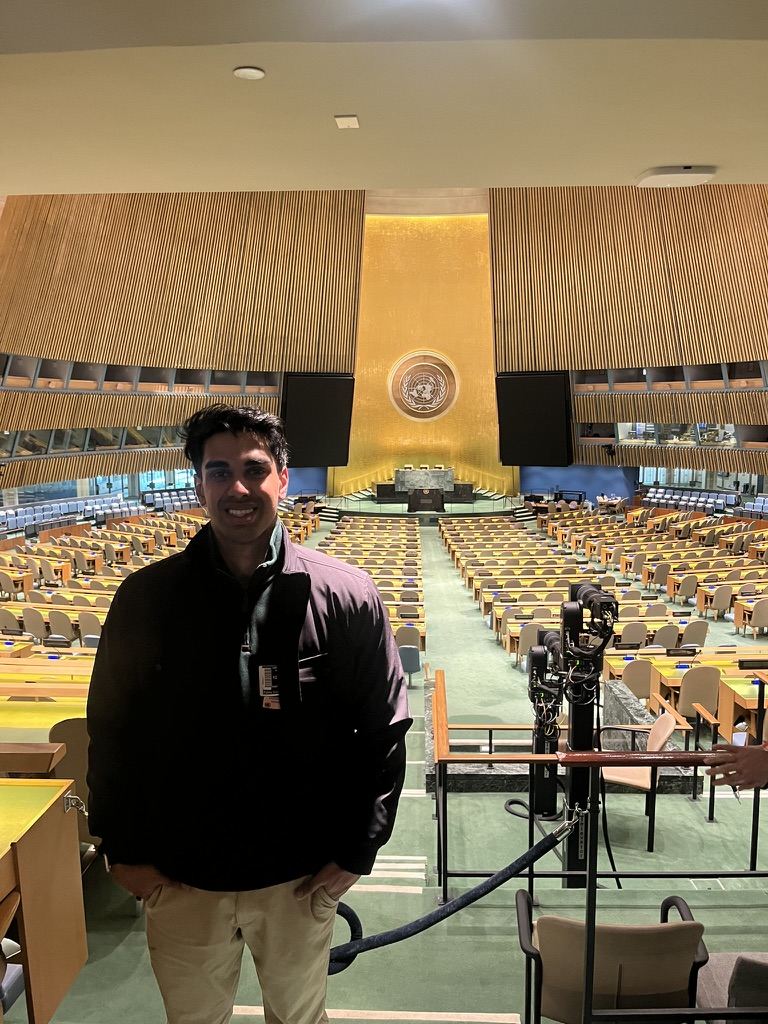
My goal became to work in a field that is taking the steps to ensure those like me are afforded the luck I was; development finance, and specifically the UN. Over the last 6 years, I’ve had the joy of studying in 5 different countries, worked with multiple UN – affiliated organizations, and at each step of the way I’ve (very proudly) explained my disability to colleagues who’ve never heard of it. Even in the organisations that represent inclusion the most, awareness cannot be assumed, and advocacy is a daily endeavor.
Every year on October 6th, over 50 million people around the world mark World Cerebral Palsy Day, dedicated to celebrating the daily efforts of and raising awareness for those with the disability. Yet despite cerebral palsy being the most common lifelong physical disability, it still lacks formal recognition as a United Nations day of observance – a distinction over 210 other occasions have been bestowed.
UN recognition would be more than symbolic. It would create a global platform to not only raise awareness and challenge stigma but turn it into action – focusing on persistent barriers people with cerebral palsy face in education, healthcare and employment. It would also give advocates—particularly in countries where disability remains underfunded or invisible—a powerful tool to push for change.
Most importantly, recognising World Cerebral Palsy Day would reinforce a simple principle already embedded in the UN’s mission: people with disabilities must not merely be included in development, they must have an equal opportunity to shape it.
In order to accomplish UN recognition, the Australian government must formally nominate and support World CP day– an incredible opportunity to further expand what began far down under in Sydney, Australia 15 years ago now brings together 187 partner organisations around the world. Australia has become a leader in Cerebral Palsy awareness, helping shape and change the future of research, early diagnosis and treatment. It now has the opportunity to lead again, taking what it started all the way to the UN.
So the ask is simple: We are urging the Australian government to formally support World Cerebral Palsy Day for UN recognition. October 6th already has a global community of 50 million behind it. It’s time the UN give that community a global stage.