We’re proud to share a significant milestone for our community.
After years of disability-led campaigning by young people with cerebral palsy, the NSW Education Standards Authority (NESA) has released new exam provision guidelines that will make the HSC fairer and more accessible for students with disability.
For us at CPActive, this is more than a policy update, it’s a powerful example of what’s possible when people with lived experience are in the room, shaping the systems that affect their lives.
Young people from CPActive have spent years advocating for these changes, meeting with NSW Disability and Education Ministers, and working directly with NESA to highlight how existing exam provision processes were creating unnecessary stress, barriers, and inequity for students with cerebral palsy.
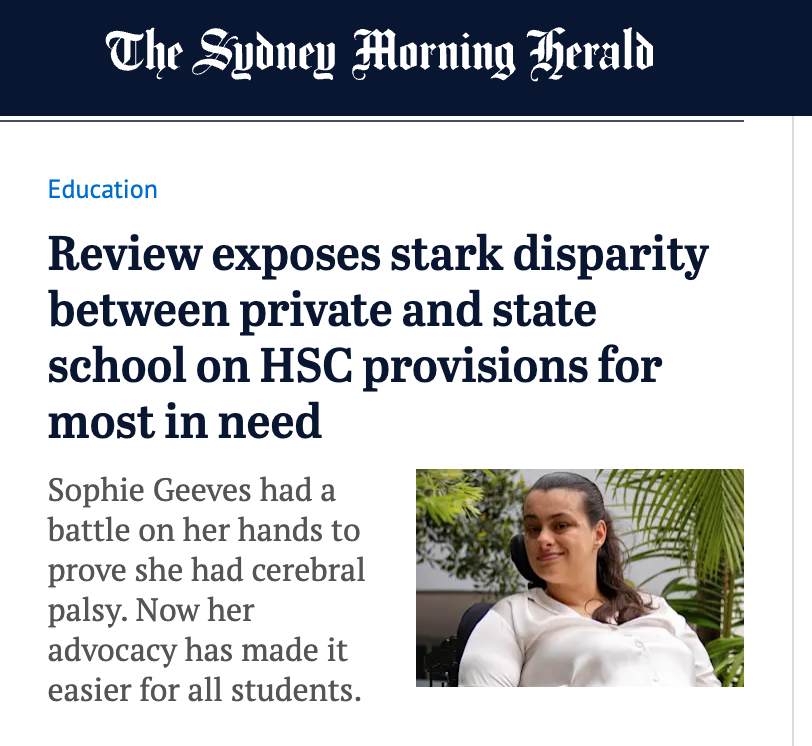
CPActive campaigner, Blaze the Trail ambassador Sophie Geeves, 28, from Sydney, says the reforms represent a major turning point.
“This is a huge moment for our CPActive community. This is what true co-design looks like – and it works,” Sophie said.
“For too long, students with disabilities have had to fight just to get a fair go in their exams. And they’ve had to fight over and over again just for the same thing every time a new set of exams rolls round.”
The new guidelines introduce several long-called-for changes that will reduce stress for students and families during what is already an intense period of schooling. Importantly, they will benefit not only students with cerebral palsy, but many students with disability more broadly.
“The new guidelines will reduce the stress facing students with disabilities and their families during what is an already intense time of life of their senior years,” Sophie said.
“The announcement from NESA demonstrates the power that people with disabilities can have when we campaign together.”
One of the most significant reforms is the ability for students to apply for exam provisions from Term 2 of Year 10, rather than waiting until senior years. This earlier timeline allows students to have supports in place well before the HSC, giving them time to practice using the provisions they’ll rely on in exams, and avoiding last-minute applications and uncertainty.
Another major win is the recognition of assistive technology. Under the new guidelines, students who consistently use technology for learning will be able to use that same technology in their HSC exams, without needing to reapply repeatedly. This has been a core focus of the Blaze the Trail campaign.
For students like Lachlan Woodfull, 18, from the Hunter Valley, the changes are life-changing.
“The extra work it takes just to organise the right exam supports takes a huge toll on students and their families,” Lachlan said.
“I’ve experienced this first hand – where I’ve recently had no choice but to learn how to use a scribe, instead of being able to use the technology I normally do.
“The new changes will mean that I can use my technology to complete my HSC exams, which is a huge relief.”
CPActive campaigner Riley Saban, 23, from Coffs Harbour, says the reforms recognise something students with disability have always known.
“I do all my learning through a device, so of course I need to use that same technology in the exam room,” Riley said.
“Students like me shouldn’t have to reapply over and over for something as basic as this. Now, it’s finally being recognised as standard practice, and that’s a big win.”
Other changes introduced through the new guidelines include:
- Removing the requirement for ongoing medical evidence for lifelong disabilities such as cerebral palsy
- Stronger quality assurance to ensure schools are properly supporting students
- Clearer and more accessible information about the application process
For Sophie, who has been campaigning for these reforms since 2023, the impact is clear.
“These simple changes alone will make a real difference to so many students,” she said.
The Blaze the Trail campaign was launched by CPActive in 2022 to address systemic barriers faced by people with cerebral palsy in education, employment, and the broader community. This NSW outcome shows what can be achieved when young people with disability lead advocacy for change.
But while we’re celebrating this win, we know the work isn’t finished.
Right now, students’ access to fair exam provisions still depends on where they live. Outside NSW, there are no consistent national standards to ensure students with disability are supported equitably.
As Sophie explains:
“Thanks to the success of our campaign in NSW, new exam guidelines have just been released – making the process of finishing school and beginning the next chapter of our lives fairer for students in NSW.
“But there’s still a problem. Right now, there’s no national standards to ensure that other students with disabilities across Australia, outside of NSW, have access to these supports.
“Whether young people with disability have a fair experience in their journey from school to work is a postcode lottery. It’s time to change that.”
We’re now taking Blaze the Trail national, calling on all state and territory governments to commit to clear, consistent, and enforceable guidelines for exam provisions for students with disability.
If you support fair pathways from school to work for young people with disability, you can add your voice by signing our petition: